Principia mathematica, vol. 1 (of 3) by Alfred North Whitehead and Bertrand Russell
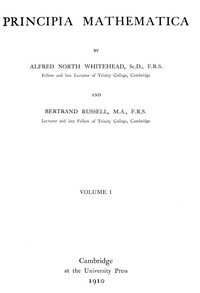
The Principia Mathematica (often abbreviated PM) is a three-volume work on the foundations of mathematics written by the mathematician–philosophers Alfred North Whitehead and Bertrand Russell and published in 1910, 1912, and 1913. In 1925–1927, it appeared in a second edition with an important Introduction to the Second Edition, an Appendix A (that replaced ✱9), and with an additional new Appendix B and Appendix C. PM was conceived as a sequel to Russell's
1903 The Principles of Mathematics, but as PM states, this became an unworkable suggestion for practical and philosophical reasons: "The present work was originally intended by us to be comprised in a second volume of Principles of Mathematics ... But as we advanced, it became increasingly evident that the subject is a very much larger one than we had supposed; moreover on many fundamental questions which had been left obscure and doubtful in the former work, we have now arrived at what we believe to be satisfactory solutions." PM, according to its introduction, had three aims: to analyse to the greatest possible extent the ideas and methods of mathematical logic and to minimise the number of primitive notions, axioms, and inference rules; to precisely express mathematical propositions in symbolic logic using the most convenient notation that precise expression allows; to solve the paradoxes that plagued logic and set theory at the turn of the 20th century, like Russell's paradox. This third aim motivated the adoption of the theory of types in PM. The theory of types adopts grammatical restrictions on formulas that rule out the unrestricted comprehension of classes, properties, and functions. The effect of this is that formulas such as would allow the comprehension of objects like the Russell set turn out to be ill-formed: they violate the grammatical restrictions of the system of PM. PM sparked interest in symbolic logic and advanced the subject, popularizing it and demonstrating its power. The Modern Library placed PM 23rd in their list of the top 100 English-language nonfiction books of the 20th century. (This summary is from Wikipedia.)
Read or download for free
For an overview of the different reading options, see our Reading Guide
| Reading Options | Url | Size | |||
|---|---|---|---|---|---|
| Read now! | https://www.gutenberg.org/ebooks/78050.html.images | 4.1 MB | |||
| EPUB3 (E-readers incl. Send-to-Kindle) | https://www.gutenberg.org/ebooks/78050.epub3.images | 92.7 MB | |||
| EPUB (older E-readers) | https://www.gutenberg.org/ebooks/78050.epub.images | 92.5 MB | |||
| EPUB (no images, older E-readers) | https://www.gutenberg.org/ebooks/78050.epub.noimages | 594 kB | |||
| Kindle | https://www.gutenberg.org/ebooks/78050.kf8.images | 45.0 MB | |||
| older Kindles | https://www.gutenberg.org/ebooks/78050.kindle.images | 46.3 MB | |||
| Plain Text UTF-8 | https://www.gutenberg.org/ebooks/78050.txt.utf-8 | 23 kB | |||
| Download HTML (zip) | https://www.gutenberg.org/cache/epub/78050/pg78050-h.zip | 27.6 MB | |||
| There may be more files related to this item. | |||||
Similar Books
About this eBook
| Author | Whitehead, Alfred North, 1861-1947 |
|---|---|
| Author | Russell, Bertrand, 1872-1970 |
| Title | Principia mathematica, vol. 1 (of 3) |
| Original Publication | Cambridge: University Press, 1910, copyright 1912, copyright 1913. |
| Note | Wikipedia page about this book: en.wikipedia.org/wiki/Principia_Mathematica |
| Credits | Richard Tonsing, Laura Natal, Michael Roe and the Online Distributed Proofreading Team at www.pgdp.net (This book was produced from images made available by the HathiTrust Digital Library.) In memoriam of Greg Newby. |
| Summary |
The Principia Mathematica (often abbreviated PM) is a three-volume work on the foundations of mathematics written by the mathematician–philosophers Alfred North Whitehead and Bertrand Russell and published in 1910, 1912, and 1913. In 1925–1927, it appeared in a second edition with an important Introduction to the Second Edition, an Appendix A (that replaced ✱9), and with an additional new Appendix B and Appendix C. PM was conceived as a sequel to Russell's 1903 The Principles of Mathematics, but as PM states, this became an unworkable suggestion for practical and philosophical reasons: "The present work was originally intended by us to be comprised in a second volume of Principles of Mathematics ... But as we advanced, it became increasingly evident that the subject is a very much larger one than we had supposed; moreover on many fundamental questions which had been left obscure and doubtful in the former work, we have now arrived at what we believe to be satisfactory solutions." PM, according to its introduction, had three aims: to analyse to the greatest possible extent the ideas and methods of mathematical logic and to minimise the number of primitive notions, axioms, and inference rules; to precisely express mathematical propositions in symbolic logic using the most convenient notation that precise expression allows; to solve the paradoxes that plagued logic and set theory at the turn of the 20th century, like Russell's paradox. This third aim motivated the adoption of the theory of types in PM. The theory of types adopts grammatical restrictions on formulas that rule out the unrestricted comprehension of classes, properties, and functions. The effect of this is that formulas such as would allow the comprehension of objects like the Russell set turn out to be ill-formed: they violate the grammatical restrictions of the system of PM. PM sparked interest in symbolic logic and advanced the subject, popularizing it and demonstrating its power. The Modern Library placed PM 23rd in their list of the top 100 English-language nonfiction books of the 20th century. (This summary is from Wikipedia.) |
| Language | English |
| LoC Class | QA: Science: Mathematics |
| Subject | Mathematics |
| Subject | Logic, Symbolic and mathematical |
| Subject | Mathematics -- Philosophy |
| Category | Text |
| EBook-No. | 78050 |
| Release Date | Feb 26, 2026 |
| Most Recently Updated | Mar 8, 2026 |
| Copyright Status | Public domain in the USA. |
| Downloads | 1111 downloads in the last 30 days. |
| Project Gutenberg eBooks are always free! | |