A guide to the history of physical education by Fred Eugene Leonard
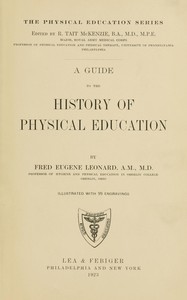
"A guide to the history of physical education" by Fred Eugene Leonard is a historical survey and reference work written in the early 20th century. It charts the evolution of physical education from classical Greece and Rome through the Middle Ages, Renaissance, and Reformation to modern European and American movements, highlighting key systems, leaders, institutions, and practices. Designed for students, teachers, and scholars, it synthesizes major traditions (such as German Turnen, Swedish
gymnastics, and the playground movement) and directs readers to authoritative sources. The opening of this volume presents the author’s and editor’s prefaces, establishing the book’s purpose, scope, and method: Leonard addresses the long-standing gap in comprehensive English-language histories, outlines decades of research across European archives and institutes, and frames the work as a guide to key stages, figures, and literature; the editor underscores the need to separate enduring systems from short-lived fads and praises Leonard’s scholarly preparation. A detailed table of contents maps a two-part structure (Europe, then the United States). The initial chapters then survey foundations: Greek education (contrasting Sparta’s state-forged military hardness with Athens’s broader cultivation; the palæstra, gymnasia, and national festivals), Roman pragmatism centered on citizenship and military drill (and later baths and public spectacles), the hardy physical culture of Germanic and Norse peoples, and the ascetic turn of early Christianity that suppressed bodily training. Subsequent chapters trace monastic and cathedral schooling (trivium/quadrivium and strict discipline), chivalric formation from page to squire to knight with its robust martial exercises and tournaments, medieval universities’ suspicion of amusements, and the Renaissance recovery of balanced training—exemplified by Vittorino da Feltre and advocated by humanists, physicians, and reformers (Cardano, Mercurialis, Luther, Zwingli, Camerarius, Comenius, Vives, Rabelais, and Montaigne)—with the excerpt closing mid-discussion of Montaigne. (This is an automatically generated summary.)
Read or download for free
For an overview of the different reading options, see our Reading Guide
| Reading Options | Url | Size | |||
|---|---|---|---|---|---|
| Read now! | https://www.gutenberg.org/ebooks/78009.html.images | 1.0 MB | |||
| EPUB3 (E-readers incl. Send-to-Kindle) | https://www.gutenberg.org/ebooks/78009.epub3.images | 3.5 MB | |||
| EPUB (older E-readers) | https://www.gutenberg.org/ebooks/78009.epub.images | 3.5 MB | |||
| EPUB (no images, older E-readers) | https://www.gutenberg.org/ebooks/78009.epub.noimages | 512 kB | |||
| Kindle | https://www.gutenberg.org/ebooks/78009.kf8.images | 3.8 MB | |||
| older Kindles | https://www.gutenberg.org/ebooks/78009.kindle.images | 3.7 MB | |||
| Plain Text UTF-8 | https://www.gutenberg.org/ebooks/78009.txt.utf-8 | 893 kB | |||
| Download HTML (zip) | https://www.gutenberg.org/cache/epub/78009/pg78009-h.zip | 3.3 MB | |||
| There may be more files related to this item. | |||||
Similar Books
About this eBook
| Author | Leonard, Fred Eugene, 1866-1922 |
|---|---|
| Editor | McKenzie, R. Tait (Robert Tait), 1867-1938 |
| LoC No. | 23002200 |
| Title | A guide to the history of physical education |
| Original Publication | Philadelphia: Lea & Febiger, 1923. |
| Series Title | The physical education series |
| Credits | Tim Lindell, Turgut Dincer and the Online Distributed Proofreading Team at www.pgdp.net (This file was produced from images generously made available by The Internet Archive/American Libraries.) |
| Language | English |
| LoC Class | GV: Geography, Anthropology, Recreation: Recreation, Leisure |
| Subject | Physical education and training |
| Subject | Physical education and training -- History |
| Category | Text |
| EBook-No. | 78009 |
| Release Date | Feb 22, 2026 |
| Copyright Status | Public domain in the USA. |
| Downloads | 5642 downloads in the last 30 days. |
| Project Gutenberg eBooks are always free! | |