
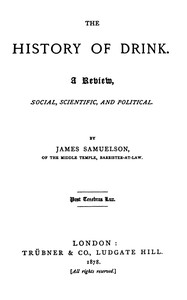
The history of drink : A review, social, scientific, and political by Samuelson
QR code
"The history of drink" by James Samuelson is a social, scientific, and historical review written in the late 19th century. It examines how intoxicating beverages arose, spread, and shaped morals, religion, law, and public health from prehistory to modern nations, arguing that excess has wrought great harm while avoiding rigid partisanship. The opening of the work lays out its purpose: to fill a gap since Morewood’s early study, sketch a broad, impartial
history of intoxicants, and inform present temperance debates without bowing to any “ism.” A detailed contents page maps a global survey. The first chapter disputes the claim that there is no instinct for stimulants, citing children, domesticated animals, Darwin’s observations of monkeys and baboons, natural fermentation, and widespread native drinks (palm-wine, koumiss), then contrasts “savage” drunkenness (African festivals, Laplanders) with moderating effects of culture, and notes prehistoric European lake-dwellers grew grapes and barley. The next chapter turns to China: ancient classics show ritual drinking endorsed but drunkenness condemned (an imperial edict threatens severe penalties), poems depict court and peasant feasts, Buddhism later enjoins abstinence for monks, and in modern times rice spirits are common yet public drunkenness is rare, with opium and poverty altering the pattern. The third chapter treats India: Vedic ritual centers on intoxicating soma, hymns revel in a drunken Indra, the laity favor the stronger sura, and later law (Manu) fiercely denounces drink even as many liquors persist; today most Indians are temperate except at certain festivals (e.g., Holi) and among lower castes using arrack or bhang. The fourth chapter contrasts Zoroastrian disapproval of drunkenness with Persian practice ancient and modern, and shows that despite Islamic prohibitions many still drink privately; the fifth chapter opens by challenging total-abstinence readings of Hebrew Scripture, arguing the texts promote temperance rather than an absolute ban. (This is an automatically generated summary.)
Download for free
For your e-reader or reading app — Kindle, Kobo, Apple Books, Calibre etc.
Kindle → Use Send-to-Kindle
Kobo, Nook etc. → Transfer via USB
Phone, tablet or computer → Open in a reading app
Other formats & older devices
There may be more files related to this item.
About this eBook
| Author | Samuelson, James, 1829-1919 |
|---|---|
| LoC No. | 15010471 |
| Title | The history of drink : A review, social, scientific, and political |
| Original Publication | London: Trübner & co., 1878. |
| Credits | Tim Lindell, Turgut Dincer and the Online Distributed Proofreading Team at www.pgdp.net (This file was produced from images generously made available by The Internet Archive) |
| Language | English |
| LoC Class | HV: Social sciences: Social pathology, Social and Public Welfare |
| Subject | Temperance -- History |
| Subject | Drinking of alcoholic beverages -- History |
| Category | Text |
| eBook-No. | 77418 |
| Release Date | Dec 7, 2025 |
| Copyright | Public domain in the USA. |
| Downloads | 417 downloads in the last 30 days. |
Project Gutenberg eBooks are always free!