A Little Girl in Tears
The appetite for adventure grows by being fed. There was a night when Morley Smith, clubman and close to fifty years old, spurred by a chance book of fiction, let the check-boy at the club ease him into his eight-hundred-dollar fur-lined coat and sallied forth in a taxicab to seek adventure in a house chosen at random. Trivial as the adventure had been, it was a stirring event in Morley Smith’s placid, well-groomed life. For a week he munched it in his mind and was satisfied. He glowed with a feeling that he had seen life. Then came the urge to further adventure.
When he had finished his ample dinner at the club, washed down by a half-pint of good sauterne (his favorite dinner-wine), Morley Smith had retired to the smoking-room, nothing farther from his mind than the thought of going out into the miserable, drizzly night. It was an excellent night on which to sit in drowsy comfort in the club, and he settled himself in a big chair, with a fat cigar and the daily paper. It may have been so slight a thing as a whispering of uneasiness in a region under his waistcoat where all was usually placid. Without knowing why, Morley Smith felt a vague discontent. He tossed the newspaper onto the table.
“Oh, piffle!” he murmured.
For an instant he thought of the opera—which bored him always. He thought of his favorite musical comedy, and thought of it with distaste. Suddenly, with the impetus of a flood, there swept through his consciousness a memory of the tremulous moments during his first amateur adventure, when he was not sure whether he would be kicked out of the apartment into which he had so daringly ventured, or accepted as a lawful visitor; and he desired once more to feel that thrill. He tapped the bell at his side.

“Henry,” he said, “a taxi!”
“Yes, Mr. Smith,” Henry said. “There is one outside now, sir.”
There was now, in a manner of speaking, no turning back. Of course he might, if he chose, tell Henry he had changed his mind, or he might order the taxi-driver to carry him to this or that theater, but as an amateur adventurer, such faltering was not according to the rules of the game. The adventure began when the first word was spoken. When he was buttoned into his fur-lined coat and stood with one foot on the step of the taxi, the adventure was well along.
“Where to, Mr. Morley?” asked the driver.
On his way from the coat-room to the street, Morley Smith had plunged deeper into adventure than he had ever imagined possible. This time he would choose no quiet, respectable street but plunge into the heart of danger, where adventure teems. He would leap into the heart of the black area known as the East Side—vaguely so known to Morley Smith.
“East Houston Street,” he said. “I say, I don’t recall the number, what? When you get there, drive along a bit slowly, old chap, and I’ll know the place.”
This was going it strong. He halted the taxi before a tenement-house that was as like all the others on the block, as one third pea in a pod is like the fourth and fifth. He stepped out of the cab and looked up at the façade of the building, The East Side!
“Wait here for me,” he said, and the driver clambered down and threw a robe over the hood of his cab. Discretion is the better part of valor. It was as well to have the cab at hand.
In the entrance Morley Smith did not find the row of letter-boxes he had expected. Here, evidently, one did not push a button; one entered and went where he chose. He looked up the dusky stairway. A man was coming down. Morley Smith stood until he should pass, for the stairway was narrow. The man stopped.
“Here already? That’s quick work!” he said approvingly. “It’s the fourth floor, the first door on the right. Go right up.”
“Thank you,” said Morley Smith, and he went up the stairs.
As you mount the stairs in a tenement, one side of the building is on your right. When you reach a landing and turn onto the floor of the dark, narrow hall, the other side of the building is on your right. Morley Smith’s heart was beating rapidly, either with the elation due to the adventure or the exertion of climbing the stairs, as he knocked on the door to his right, after trying the bell in vain. He rapped as a soft-knuckled clubman would rap, not noisily but with authority, and at the second rapping the door opened.
A girl, not more than sixteen, thin, big-eyed and pale, answered. The room behind her was so scantily furnished as to seem but a temporary lodging-place. There was no carpet on the floor. On a couch pushed against the opposite wall was an unmade pile of cheap bedding; there was no chair and no table. Instead there were a short, nondescript wooden bench and a packing-case on which stood an oil lamp. On the box were a bottle of milk and a loaf of bread from which perhaps half had been cut away. On the wall, on hooks, hung several articles of female wearing-apparel and a dowdy little hat. The feather of the hat was still wet, or had dried while preserving its water-soaked appearance. All this Morley Smith saw, but more clearly he saw that the face of the girl was streaked with tears, and that tears still glistened in her eyes. She supported herself against the door-frame; in her hand she held a wad of wet handkerchief, and she used it on her eyes before she spoke.
“This is the wrong door,” she said. “It is the door across the hall.”
Morley Smith might have answered that no door was the wrong door for him, since no door was the right one. Instead he said “I beg pardon?” questioningly, while his eyes took the girl in.
“It is the door across the hall,” the girl repeated. “You are the undertaker, aren’t you?”
In the course of his first adventure Morley Smith had accepted the suggestion that he was an insurance-adjuster, and he was ready to accept almost any similar suggestion if it might further his adventures, but he recoiled from the necessity of posing, even temporarily, as an undertaker.
“My word, no!” he exclaimed. “By Jove, now! I don’t look quite that, do I?”
The girl stared at him doubtfully.
“What?” queried the clubman.
“But you aren’t—you can’t be—” she exclaimed, almost with eagerness, and her tone was a question.
Morley Smith’s heart beat even more rapidly. The adventure was moving swiftly and well. With a feeling that he was casting all precaution to the winds he answered.
“But I am,” he said. “Jove, yes! Who else would I be?”
The girl drew the door more widely open and stood aside.
“I didn’t know,” she said. “I—I thought, from the name, you were a—a lady, of course, or I wouldn’t have asked you to come here. But you can come in. I’m not afraid.”
“By Jove, no!” said Morley Smith. “Why should you be?”
He wondered who he was, that she had thought, from his name, he was a lady. This, he thought, was jolly well worth while; it was ripping, don’t you know! A girl in tears, and a corpse across the hall, and bread and milk on a raw pine box, and all that sort of thing—what? It might be some trick; she might try to blackmail him, but what of that? That in itself would be adventure, for he had never been blackmailed. He entered the room, and the girl closed the door. She stood with her back against it, with her hands behind her and on the knob, as if to prevent his leaving or to facilitate her escape if need be. Morley Smith placed his hat on the top of the packing-box, where it touched elbows with the milk-bottle and the half-loaf.
“Well?” queried the girl.
With care, pulling them by the fingers, Morley Smith removed his gloves, looking around the room the while. He placed them on top of the hat. There was no stove in the room—no heat except what came from the lamp. He removed his heavy coat, for all that, and laid it on one corner of the couch. He was trying, with a brain untrained to such work, to formulate words that would set the girl at ease and lead her to tell her story, if she had any story to tell. He frowned and looked at his well-manicured nails. When he looked up, the girl was holding a sheet of note-paper, looking at it. It was evident enough that she was trying, by rereading some letter, to convince herself that the presence there of Morley Smith—whoever she supposed him to be—was right. She seemed less doubtful now, and folded the letter with one hand, putting it in a pocket in her skirt.
“You must be quick, Mr. Cardigan,” she said. “He may be back any minute now.”
“Ah, yes! So he may,” Morley Smith said.
“She is over there,” said the girl, pointing across the hall. “I thought it would be all right; she was always so fond of the child. She loved it, Mr. Cardigan. She spent hours with it while it was ill. I thought it would be no harm for her to go there.”
“Quite so. Yes, indeed,” said Morley Smith.
Suddenly the girl seemed to have a return of whatever suspicion had lurked in her mind. Perhaps it was that Morley Smith stood so long and so strangely, staring at her. Something like a sudden fear shone in her eyes, and she took a step forward—one step and then collapsed in a heap on the floor, a pitiful little heap of unconsciousness.
Had he not been seeking adventure, the turn affairs were taking would have annoyed Morley Smith exceedingly, but he felt an uplift of heart. The adventure was becoming worthwhile. It held mystery, a danger, a fair young woman in evident distress. He gathered the girl in his arms and carried her to the couch and laid her on it, her head resting on his soft, expensive coat. He hardly knew what to do next. That she had fainted was evident enough,—probably from undernourishment,—and he had a vague impression that when one fainted it was desirable to unloosen something and use a cold liquid, but there was no liquid but the milk in the bottle on the packing-box, and the girl’s gown seemed loose enough, turned low at the neck. He reached across the short space intervening for his hat and began fanning the girl with it. As he fanned, he heard some heavy-footed person coming up the stair. “The undertaker,” he thought, “or the man she fears will return too soon.” He looked up to see the door open and a man standing on the sill, questioning and doubtful.

The man was young, rough in appearance, and seemed powerfully built. He was, Morley Smith felt sure, the “he” whose return the young woman had seemed to dread. There was something the girl had wished done before this man returned. Morley Smith was not a weakling; he measured the young fellow with his eye as the youth crossed the room. He might try to throw the young man out of the place, and he had an impulse to do so. He straightened himself for the work if it should be necessary, but the young fellow came and bent over the girl and then looked up at Morley Smith questioningly.
“Thank God she’s not dead!” he said; and then: “Is she very sick? Lord, what a place for her to be in! Can’t we get her out of here, into a better sort of place? I’ve got some money, not much, but you can have all I’ve got. Don’t you know of some hospital or something you can get her into, Doctor?”
“So I am a doctor now, am I?” thought Morley Smith. He rather preferred being mistaken for a doctor to being thought an undertaker. “I dare say!” he said, answering the young man. “Ah—quite so!”
He felt the lapel of his waistcoat, where his eyeglasses swung on their silken ribbon. He adjusted the glasses on his nose.
“And may I ask who you are?” Morley Smith questioned.
“What do you care who I am?” demanded the young man. “She’s your job; don’t you worry about me. Can’t you do something? She’s not dying, is she?”
The distress that shone upon the young man’s face reassured Morley Smith. This young man was not going to attack anyone.
“She has only fainted,” Morley Smith said. “But I say, now, who are you?”
“None of your—” the young man began, but he thought better of it. “Never you mind me,” he said. “I’m her friend, if it comes to that. Me and her used to be engaged, if you want to know it. We used to be—”
“Sweethearts?” asked Morley Smith.
“That’s it. We was going to be married, but she chucked me. I guess I’ve got a right to butt in on this—look how she has been living.” He cast a glance at the room. “Say, can’t you do something?”
Morley Smith took the girl’s hand.
“You might get some water,” he said. “Cold water, what?”
The young fellow looked for a utensil and took up the milk-bottle. Unceremoniously he threw the remaining milk on the floor and went to the door at the end of the room. It opened under his touch, and Morley Smith saw a second room, hardly less bare than the one in which he was. Here was a cheap white iron bed with tawdry coverings, a gas-stove, a sink. The room was evidently bedroom and kitchen combined—a room of the utmost poverty. The tap yielded water, however, and the young man came back with the milk-bottle filled. Morley Smith, with a feeling of oddity, for he was doing that which he had never expected to do, poured a little of the water into his hand and wet the girl’s forehead.
“Say, I’d better not be here when she comes to,” said the young man. “She ain’t wanting to see me, you understand? You let me wait in that other room there, and if it’s all right—if she looks like she could stand it—you tell her John Dredd has been here. You—”
The girl moved. The young man did not wait. He fled to the kitchen and closed the door. Once more Morley Smith wet his hand and moistened the girl’s forehead. She opened her eyes, looking at Morley Smith dazedly. Then she sat up, letting her feet slide to the floor. Womanlike, her first act was to put her hand to her hair.

“I fainted,” she said.
“Quite so!” said Morley Smith. “Jove, yes!”
The girl placed her hands on the edge of the couch, not attempting to rise.
“I feel queer,” she said. “Let me sit here a minute, and I’ll feel all right, I guess. I’m sort of weak, you see. I’ve been sick,” she explained, “and I aint strong yet. She hasn’t come in yet?”
“No,” said Morley Smith. He did not know who “she” was, but the girl evidently referred to the person in the room across the hall, the person who had been so fond of the child, whoever the child had been. The girl leaned forward, breathing a little hard, and letting her chin rest on her chest.
“And he hasn’t been here yet?” she asked.
“Who?” asked Morley Smith. “John Dredd?”
As if the shock were greater than a splash of icy water, the girl sat straight, her eyes suddenly alive again. She put her hand on Morley Smith’s arm.
“What do you know about John Dredd?” she asked tensely. “He’s not here? He hasn’t been here?”
What her emotion was that caused her to utter the questions with such thrilling feeling, Morley Smith could not know. He thought he detected fear—an overwhelming fear.
“I say,” he said, “you don’t see him in the room here, what?”
The girl seemed relieved. She removed her hand from his arm.
“I don’t get things clear yet,” she said. “I’m dizzy yet, I think. You did say John Dredd, didn’t you? Tell me! Please, tell me! Has he been here? Was he here while I fainted?”
“You’re a bit off your head yet, what?” said Morley Smith. “Imagining things, what?”
For answer the girl struggled to her feet. She was still so weak that she had to put out a hand and support herself by holding to Morley Smith’s arm. She stood thus a moment and then leaned against him, closing her eyes and swaying.
“I must get her now,” she said, catching her breath and making an effort. “You must get her away before Father comes back. She will go with you. You’ll tell her it will be all right. Tell her—tell her I’ve found a job for her—that you have found one. Braiding carpet-rags! Tell her it is a good job, and that the money will be enough to take care of me in a hospital. She will go with you then. That’s all she wants now, to have money to send me to the hospital. And she will not be any trouble to them. Just some rags torn up, so she can braid them, and she will sit and be no trouble at all. They need only remind her that she is doing it to keep me in the hospital, if she forgets. They can tell her I am getting well, and she will sit and braid all day.”
She took a step toward the door; but the door opened and a woman stood in it.
“Come in, Mother,” the girl said; but the words were not necessary, for the woman did not hesitate. She might have been fifty, but she looked older, her dark hair being streaked with gray and her countenance pinched and pallid. She crossed the room to Morley Smith, her thin hands clasped against her breast, and looked up into his face with the pitifully questioning look of a child in her eyes.

“It is all right, Mother,” the girl said reassuringly. “It is Mr. Cardigan—Mr. Francis Cardigan. I told you about him—don’t you remember, Mother? He is going to show you where the work is, the easy work you can do to earn so much money, so I can be well.”
The poor creature looked from Morley Smith to her daughter and back again.
“But it was a woman,” she said falteringly. “It was a woman. Wasn’t it a woman?”
She appealed to her daughter, trouble in her eyes. The girl drew the letter from her pocket.
“I said it was a woman, Mother,” the girl answered. “See, I thought the name was Frances, Mother.”
The woman took the letter in her hand and held it, but did not look at it. Instead, she questioned her daughter’s eyes, and she saw truth in them.
“Yes; let us go at once,” she said eagerly. “Get me my hat, Mary; I have a hat, haven’t I? It doesn’t matter. Take me quickly; I must get to work,” she begged, appealing to Morley Smith. “I must earn a great deal of money, for Mary must go to the hospital. Take me now, please.”
Morley Smith had taken the letter from her hand and was reading it. He could not make much of it. The signature might have been Frances Cardigan or Francis Cardigan, having been hastily scrawled. It said all arrangements had been made and that the writer would call that evening, ready to conduct the mother as arranged. A cab would be in waiting, the letter said. He dropped the letter on the couch.
“She is right,” said the girl; “you had better take her before Father comes back, or there will be trouble. It will be all right, Mother; you need not fear anything; and if—if you ever grow tired of the new place, you will remember you are doing it for me, so I can get strong and well again. She has no hat,” she said to Morley Smith apologetically. “You won’t mind taking her as she is?”
“It is cold out, you know,” said Morley Smith.
“I’m sorry! She has no coat; neither have I,” said the girl. “Father took them.”
“By Jove, now!” said Morley Smith. “So you couldn’t get away, what?”
“For whisky,” said the girl simply, as if that explained it all; and so it did. Slowly, for he was not a man of brilliance of thought, Morley Smith began to understand things. This girl was trying to get her mother away to some place where she would be cared for; and it seemed the father objected. He was evidently a drunken brute.
Morley Smith was puzzled. His adventure was leading him into a difficulty he did not know how to handle. He couldn’t take the old dame away, what? He couldn’t take her down to the cab and bundle her in when he did not know where she was to be taken! For a moment he felt as if wisdom indicated that he should make some excuse and go out of the door and down the stair and disappear forever, but that would be a paltry ending for his adventure. There was something else, too, that forbade his flying in any such way; his sleek, clubman soul was annoyed and irritated by the room, by the poverty, by the pitiful weakness and distress of the two women. To sneak away would be but a tame and inefficient conclusion.
“I say!” he exclaimed suddenly.
He had had what seemed to him a glowing, brilliant inspiration. It had come to him like a flash of light out of darkness. The girl looked at him questioningly.
“I’m not that Frances Cardigan,” he said. “No! Bally strange, I call it, what? Same name and all that sort of thing, don’t you know. She may be a cousin of mine—cousin Fanny, what? Just so!”
The girl’s eyes filled with trouble.
“But who are you, then?” she asked. “What are you doing here?”
“I’m the lawyer,” said Morley Smith.
“Jove, yes! I’m the lawyer chap—the lawyer Cardigan. Hunted you up here, and all that sort of thing, don’t you know! Lost will, and that sort of thing, just like a book.”
“Oh!” said the girl, staring at him wide-eyed. “Oh! Then—then that is how you knew about John Dredd?”
“My word, yes!” said Morley Smith. “Imagine your not guessing that! I would know about John Dredd, wouldn’t I?”
“You were hunting for us? At Watertown? But—” The girl seemed to search her memory. “But who would make a will? Who would lose a will? Not Uncle Henry?”
“Jove, yes!” exclaimed Morley Smith. “You hit it the first time, what! Uncle Henry!”
“Uncle Henry!” said the girl, and as the thought that there might be some money came fairly into her mind, she drew a deep breath. Then her dejection returned like a load too heavy for her to bear. “But he would have had nothing to leave—nothing to make a will for,” she said.
“No, by Jove!” said Morley Smith, mentally figuring how much money he had in his wallet in his inner pocket. “Not much. He wouldn’t have—your Uncle Henry. Five hundred dollars, what?”
“Five hundred dollars!”
It was like a sigh of utter relief such as a doomed soul might utter when a reprieve came unexpectedly.
“It’s jolly well five hundred dollars,” said Morley Smith. “And no red tape, what? Just sign your name and that sort of business. Then I hand the money right over to you. Yes!”
“Did he leave it to me?” asked the girl, opening wide her eyes.
“Right-o!” said Morley Smith.
“But—but I was not born when he died,” said the girl. “He did not know there was ever going to be any me. How could he—”
“I say, now!” said Morley Smith. “That’s all law-stuff, what? Ordinances of the Board of Aldermen, and by-laws, and Constitution of the United States, Volume Fourteen, and all that sort of thing. Jove, yes! That’s what we lawyers are for, what? Article Nine, Section Seven, and all that sort of thing.”
He was taking his wallet from his inner pocket, and he opened it and began counting the bills down on the packing-box.
“Are you sure, quite sure, it is all for me?” asked the girl tremulously.
“Two hundred and ninety, three hundred, three hundred and fifty—” counted the amateur adventurer. “Four hundred—”
He stopped short with the last bill, a fifty, in his hand.
“Right-o!” he said. “You’ll have to show me who you are! Proof, you know, and all that; tell me all about yourself, and all that. I say, I almost forgot to make you prove that you were you, didn’t I?”
“Because,” said the girl, while her mother looked from one to the other with dazed, uncomprehending eyes, “I know the money can’t be for me. I’m Mary Singleton, and this is my mother Martha Singleton, and my father is Edward. My mother was a Jarney—Mary Jarney. My uncle—the one I thought of when you spoke—was Henry Jarney, but he was always poor, and he died before I was born.”
“I say, now!” said Morley Smith. “But how did you all get here, you know?”
“We came away from Watertown,” said the girl. “It was my fault; there was a boy—a young man—I wanted to punish because he had flirted with another girl, and Father had an offer of a job here in New York, so I made him come. And Mother wanted to come. Father had taken to drink, and she thought he might quit it here, with so much else to interest him; but it was worse here, and he lost his place and was always drunk. So I got work, and Mother—”
The girl touched her forehead with her hand.
“But not badly,” urged the girl. “Oh, she is not bad! Father wants to send her to the asylum, but I know it would be worse for her there, so I wrote to the Society, and they sent some one, and they thought as I did; but Father was mad with anger. He swore he would cut all our throats. That was why I wanted you to hurry, when I thought you were from the Society.”
“Oh, I say, now!” exclaimed Morley Smith.
“Yes, I did not know what he would do if he came back and found you here, or found you taking Mother away. I don’t know what he will do if he comes back now. If he will listen while you tell him about the money—”
“Give him a bit, to get rid of him—what?” suggested Morley Smith.
“Yes, that was what I thought,” said the girl, “if the money is really mine. If he had a dollar or two, he would go out and not come back until it was all spent, and before then Miss Cardigan might come for Mother.”
“To take me where I can earn a great deal of money for Mary,” said the poor woman brightly. “Money to make Mary well.”
“I have been sick, you understand,” said the girl, “and I ought to be in a hospital now.”
The mother wandered to the door and looked out, listening.
“So you understand now why I was frightened when you spoke of John Dredd,” the girl said. “I had written to him.”
“For a bit of cash, what?” asked Morley Smith.
“Oh, no! Not that!” exclaimed the girl. “To say farewell, for—for the last time—forever! I thought Mother would be where she would be cared for, and Father has been nothing but cruel and unkind, and I am so ill and so sick of everything. I hoped I would be dead and through with everything by now, Mr. Cardigan! Then they put me off for a day, the people at the Society, and I had to wait, although I had written to John that I meant to—to die. So I was afraid he might have come. I was afraid he had received my letter and might be here, and I wanted to do what I had written—after Mother had gone. It was silly of me to think he had come, for I don’t know where John Dredd may be by now. He may be anywhere in the world, or dead. He probably does not care where I am, or whether I am dead or not. But now,” she said more cheerfully, “I will go to the hospital—if this money is mine. I will get well.”
“Jove, yes!” said Morley Smith. “There’s not a bit of doubt you are the girl.”
He felt in his pocket for something she might sign, and found the latest annual statement of his club. He made her sign her name to this—on the blank sheet—and tucked it carefully away in his inner pocket. This adventure was working out nicely. He had plunged into it, and he was getting out again, and that is the ultimate perfection in adventures. The few dollars meant nothing to him; he had more than he knew what to do with.
“Right-o!” he said cheerfully. “So now I’ll just be toddling along. Good night!”
“You are sure it is all right?” the girl asked as he drew on his coat and sought his hat and gloves. “It means so much to me—it means life, and health.”
“Quite sure!” said Morley Smith, and he bowed himself out of the room and closed the door. He was sure he heard the girl sob then. He stood an instant, with his hand on the knob, to make sure, and then opened the door enough to look inside. The girl was clasping her mother in her arms in an agony of love.
“I say!” said Morley Smith. “The chappy you mentioned—John Dredd—he is in the other room, what? I all but forgot the poor beggar!”
Again the girl made the quick, feminine gesture of smoothing her hair. She went white and put her hand to her heart, and then she smiled and walked toward the other door, bravely, and Morley Smith closed the door and turned.
Across the hall the door was open, and he had a momentary glimpse of the interior of just such another room as the one he had left, but by the poor bed a woman was kneeling, and a man stood at her side, his back to the door. His hand was on her shoulder and his head was bowed.
“Jove, yes!” said Morley Smith softly, but what he meant he did not know, although we can guess. He tiptoed down the stairs very quietly, and when he was in the drizzling outer air again, he repeated the words: “Jove, yes!”
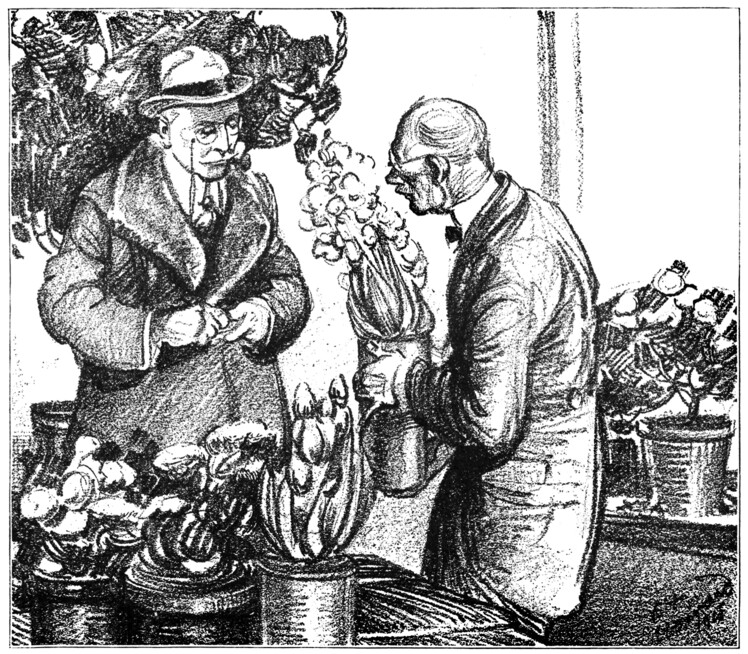
Perhaps he meant that adventuring from a comfortable club chair was well worth while, for he stopped at the first florist’s and sent white flowers to the room where even the sympathy of a poor woman with mind estranged had been welcome.
Transcriber’s Note: This story appeared in the August 1918 issue of The Green Book Magazine.